Sunday, June 3, 2012

The Road to Donghen

The road to Donghen is the road to Vietnam. This becomes apparent when tour buses printed with “Da Nang” and the names of other Vietnamese cities speed past us. We wend our way in a Ford pickup between shock-killing potholes and seams where the pavement has simply buckled and left scars a foot high or higher, but apparently the bus drivers have these pitfalls memorized and know when to pass.
Actually, our caravan is two pickups, our numbers swelled to sixteen, the standard posse size these days as friends and relatives join our adventures. The road to Donghen is a celebration. We stop along the way and are mobbed by salesmen offering various goodies, from green mangoes with spice to fruits to grilled chicken. We load up; we look for a place to picnic.

The road to Donghen is a road through the Lao countryside of forests and rice paddies, and this is planting season, when men and women in straw hats plow and sow the wet clay fields, the brown seed arching up in a dust-like cloud. Then, when the young rice has grown up thick in an improbable, bright green, they uproot the rice, bunch it in groups of three shoots, and replant that new plug, spaced inches apart. The process is age-old, labor-intensive, and still the way of the peasants in fields outlined by mud ridges. Big operators, I’m told, plant the rice once, by machine, but the Lao countryside to Donghen is still the road of the classic rice paddy.

The road to Donghen, then, is a road to the past. It’s the past we’re going to visit. Sy’s brother Pong has joined us, and Donghen is his birthplace, as well as the site of the glory of my mother-in-law’s youth. As if to confirm this, at one point there’s a detour down a mud road. It’s the rainy season, which means a layer of brown water covers a good portion of the road, masking wash holes that are deep enough to scrape the bottom or our vehicle.

Oddly enough, the road to Donghen—for Sy’s family—runs genetically through China. Sy’s grandfather, a Chinese immigrant, left his family in China and came to Laos for economic opportunity; he met Mouth Meksavanh, Sy’s grandmother, in Savannakhet, and began a new family, never to return to his family in China. In the fledgling country of Laos in the early 1950s, Donghen had both a military base and officers’ training school, and that meant hungry, moneyed men. Sy’s Grandpa Chung moved here with Sy’s grandma and their seven-year-old daughter Keohomchay and opened a restaurant-store, one probably not unlike many that still line the roadway.

As I said, the road to Donghen is in some ways a glory road. Keohomchay grew up in Donghen, her mixed Chinese-Lao heritage giving her a light skin and fine nose. In short, she was a looker. With a couple of her friends also working the restaurant, business boomed. “We were young and pretty,” Keo states matter-of-factly, “so business was very good.”

Donghen today is a busy small town. Locals drive their tractors and carts to town to buy supplies and sell produce. Street-front businesses sell motorcycles and new tractors. Just off an open space that once might have been a town square, the locals hold their dalaat sao or morning market, a tidy, compact market compared to the sprawling bustle of the Savannakhet equivalent. But the specter of war and the military still hang over the community. Keo points to what looks like a concrete water tower and says, “That’s the base.”

The road to Donghen is a road to a different time, a different standard. Our company of sixteen commandeers a rice paddy shelter along the side of the road about a mile from town. No one’s worried that we have no ideas whose shelter this is. This is not the way of things, of worrying who owns what. When we spot a farmer working nearby, we invite him to the party. “Hey, come and eat,” one of the women hollers to the man chopping down weeds with a machete along the edges of his fields, a command that is also a request to use the shelter.

As Pong and I return to town for Beerlao to complete our meal, he says, “Hey, look at this. You seen this?” He points to a small plant at his feet with tiny oblong leaves off a middle stem. “We played with these all the time as kids.” He touches one of the leaves and it pulls itself together, creating a withering effect, a withdrawing into itself.

“The boys will love this,” I tell him. And they do, for at least twenty minutes they go around, finding the plants and making them transform.

After lunch, we drive the mile or so left of the road to Donghen, parking across from the market. Being here, Keo remembers someone she might look up, just two doors down from a market. Approaching an older woman under an awning, a stalwart woman with long, graying hair and square jowls, Keo accosts here, “Do you remember me?” The woman pauses for the briefest moment as the past comes almost instantly back.

“Keohomchay!”

As the older women catch up and think of others they might fetch, we take the kids through the market. As always, westerners attract attention and soon someone is asking Pong to whom we belong. Who’s our mae? When we take her to the house next door, she too had known Keo and her cousin Bounsom when they lived here. The past comes alive under this awning.

Keo cut quite a swath in Donghen, it seems. When some of her friends formed a band, Keo sang. It was at one of their performances that a young man from the officer’s training school fell in love, smitten with the young siren. He first wooed her with a letter, declaring his admiration. An educated officer-to-be and a member of one of Vientiane’s most powerful families, Khamla Sananikone was about as close to gentry as one could get in Laos. Combine these qualities with overpowering good looks—Khamla was tall and light-skinned due to some French blood—and there was no reason—or way—for Keo to resist his advances. “Oi, he was tall and light, and so handsome,” one of the women remembers, sounding smitten with him still.

Keo landed him. The couple was married in 1962; war broke out in the region in 1965, on the road to Donghen which is the road to Vietnam which is where the energy for the war came from. Keo and Khamla’s first child would die in Donghen of a diarrhea-related disease. Keo would give birth to three more boys, the last one, Phouang—Pong—was born in Donghen in 1969. With the war in full tilt, Khamla would leave the marriage without explanation shortly thereafter, and Keo would send the two older boys to live with their grandparents in Vientiane who would take them to France as the government fell apart.

Keo’s father had died of colon cancer in 1967, but Keo returned to work alongside her mother in the restaurant, along the road to Donghen, the road to Vietnam. It was there that she met her second husband, a marriage that, coupled with the war and the regime change in Laos, would lead her back to Savannakhet, then to Thailand, then to Edgerton, Minnesota. And much of Donghen would be lost to the bombing of the war, so that today the restaurant where Keo worked and the house where Pong was born are no more

But for a day on the road to Donghen, along the rice paddies and water buffalos, along the pagodas for resting during fieldwork time, through the runny brown mud of the countryside, we’re once again on the road to Donghen that is a road to youth, a road to earlier, better, simpler days, with the darker clouds of the road to Vietnam still an unreality.

Saturday, June 2, 2012

Family Picture

We’re the only people I’ve seen with cameras here. That in itself seems to be a major ethnographical observation. What does it say that we’re trying to freeze time? To preserve it in a two-dimensional form in order to take it back with us and lodge it deep within the recesses of a computer to be called forth in the future, when nothing remains as it is in the pictures? We’re voyeurs, certainly, tourists of the exotic, like visitors at a zoo.


Nowhere does this become more apparent than when photographing the poor, even when the poor are blood relatives through marriage.

We had been warned that the economic condition of Sy’s sister was not good. The story of how she’d come to this position we heard ahead of time. She’d had a job in the city of Savannakhet at a police office and had had a nervous breakdown, a shattering--due, some say now, to a curse that someone put on her, but at least due to the curse of modern existence that can make life feel nasty, brutish, short. Her family did all they could in terms of doctoring, but the final solution of the sister and her husband was to sell all they had and buy a piece of land, a rice processor, and an ice cream machine. Now they live in a house off a road to Savannakhet on less than an acre of land that they’re clearing from forest; she gets pennies to husk the rice of local farmers; he works the road somewhere selling ice cream. They have one child, a boy, four years old.

“House” needs to be qualified here, too. It’s a shanty-shed combo, the shanty made up of long thin trees bound together under a tin roof. When we arrive, Sy’s sister is working in this shed, pouring brown rice into one of the funnels or chutes of the rice processor. The first round seems to sift or winnow the chaff from the rice; then Sy’s sister takes the filled pail and pours it into the other chute, where the rice is finally husked, pouring out two valuable products: the bright-white grains that connote that this is glutinous or sticky rice, and a brown flour apparently made from a part of the rice plant I'm not aware of. The chaff blows out the back of the shed to a pile where the chickens scratch.

The shanty holds the rice machine; it also holds Sy’s nephew’s few toys amidst some duck eggs and a cooking fire. The chicken “kabobs” we picked up from a roadside vendor are not sufficiently done for the women in our party, so we finish cooking them over this fire. We take these skewered chickens on a path alongside the sister’s land fenced with bamboo poles and holding a pig sty as well as newly planted papaya trees and plants I don’t recognize.  On a path just behind the sister's house, mats have been spread.

This is a Lao picnic: grilled meat—savory and well-cooked to the point of almost being jerky—sticky rice, dom mach hung from a bag, fruit, and water, except today our American offering is Sprite and Coke to supplement the water. However, a couple of the people in our company are not looking pleased; this is no picnic when poverty is the view. Couple that with the fact that Sy’s sister refrains from joining us—perhaps someone is expecting their rice or perhaps it’s sheer embarrassment from not having anything to offer or from clear and apparent class distinction—and we really seem like misplaced tourists.

So the lunch festivities are rather somber. When we’re nearly done, she and her son join us; she urges her son to eat but in the end they only accept a bag of mach kaam, dried tamarind. We walk up toward the house; a new customer is here delivering his grain for processing.

We linger around the shed, waiting for something to happen, a time to sit and take off our hats for a bit, but nothing happens. We walk around to the house part of the shanty, hereto off limits—if we want to see how she lives, then why pretend, anymore, that we’re not here to look? Sy is one of the first, at the sister’s urging; our kids each look; I look. It’s one room with three Asian mattresses, which are really just well-stuffed cushions, some blankets, some clothes, a TV and a fan. That’s the extent of the sister’s simplicity, but though this is all an intended step back from stressors of city life, this is no Thoreauvian experiment. This is poverty.

Before we leave, we get pictures of the sisters standing together. It’s then that we get what she has to give: the smiles she offers seem as genuine as they can be under the circumstances. The real history between the two shows through: this is the sister who carried Sy around on her hips until they were red; this the sister who Sy remembers playing with her ear until she fell asleep.

We leave, and we’re relieved to leave. We’ve left something to help, but we’ve no idea how it may help, how big a band aid it may be. It’s all wrong somehow, American money in exchange for a morning’s visit, a look into “poverty” firsthand, and yet it’s more than nothing, more than sitting in a lovely house in Edgerton, Minnesota, and not knowing, more than not even wondering.

Still, I’m wondering about the pictures. Yesterday, I tried to capture a young mother selling mangoes along the highway wearing a straw hat and black mask. It’s an image I need to explain something about life here, I tell myself, though the woman seemed to want to pull her mask down when she saw my picture, wanted not to be anonymous.

Then, last night, with our kids in the back of a truck, I saw some international businessmen, not just with a camera but with an iPad, when they stopped and took a picture of my children. Though they took for reasons only known to them, I was uncomfortable. What were they capturing about my children? And what were their motives? If a picture is worth a thousand words, what did this picture of my children say?

And what am I saying in the pictures I’ve taken of Sy’s own sister, a woman who treated her tenderly? Can I honor her in what she gave us, a look into her hard life and a genuine smile in the midst of poverty?

Wednesday, May 30, 2012

Family History

Putting up with peculiarities in parents may be one of the hardest things we have to do this side of heaven. 

I can’t believe I just said that; it’s so American teenager of me.  Still, as we travel and live in close proximity to one another on this trip, the friction between mother and daughters is a constant undertone.  Early in the morning yesterday, for example, my mother-in-law woke up before the rest of us; she’s brought American coins along as gifts and she was counting them, letting one clink noisily against the next, waking the rest of us and drawing her daughters’ ire.  At the giveaway in the village, she was too flippant for the daughters’ liking; perennially one daughter scolds her for losing track of valuables. 

This is the perfect time to travel with our children in many respects.  They’re still amazed enough by the geckos and butterflies and chickens of Laos to keep them occupied a great deal of the time, and they still like playing card games with us to fill much of the rest of time.  They are, in other words, pre-American teen stage, even though we can see it on the horizon with our daughter, age 11—the eye-rolling has begun.
The hyper-sensitive judgment about parents may have another side, though, a wiser sort of discretion and appreciation, of which I have also seen the blooms and fruits on this trip.

My wife has multiple families: brothers from her mom’s first marriage who are close family; her full sister who is closest family; sisters and brothers from her dad’s first marriage who are peripheral.  All of these siblings but two are in the US or France.  Yesterday, after a long trip to the country, we decided to swing by the house of one of the two siblings that remain here, a woman about fifty who lives mere blocks from where we’re staying.

We pulled up to what looked like a garage with the door shut, a metal door like those used to close a store in an American mall, but dark metallic green.  Someone stepped out to rap on this door, but as she did so, a woman hallooed us from an approaching scooter.  It was Sy’s sister, apparently just home from work.  We followed her around to the side of the house into a clay yard that seemed still a mess from construction.  Apparently the conversation went something like this:  “We just dropped by to see you, your sisters are here from America.”
“I work seven days a week; I don’t have time to entertain you.”

“Well, maybe you could take us to see your dad’s ashes.”

“Okay.”

After this interchange we got back in our van and followed the sister on her cycle to the wat, perhaps a mile distant, the sister speeding ahead to the point where I thought she was making her getaway.  Of course, we lost time because we stopped at a roadside stand to buy a lighter.  Eventually, we pulled into the compound of a wat, and there was her cycle and the sister, ready to lead us.

The “compound” of a wat is walled, and inside the compound are assorted buildings, including central shrine and more minor shrines and perhaps simple barracks for monks to sleep in, though we’re unclear on this point.  The sister led us through the neatly tended grounds of this wat, complete with perfectly trimmed shrubbery and tropical flora.  A Buddhist cemetery consists of upright sepulchers stationed near the outer walls of the compound.  A given sepulcher may hold the ashes of a number of people, not so individualized like American cemeteries.  It seems slightly more impersonal, though from what I’ve seen Lao people visit these sepulchers more religiously than Americans visit cemeteries.  Wedged into a corner, we found the sepulcher that contained my father-in-law’s ashes, the like of which was replicated all around the wall of the wat. 
The sun was setting and there seemed to be some urgency to complete the rite, so my mother-in-law produced the lighter and passed out incense punks to her daughters and grandchildren.  These were placed in the ground near the sepulcher and someone said a few words as if to Sy’s dad.  Sy’s been crying, Ly joins her, crying for a man they didn’t know but who nonetheless casts a long shadow into their lives.

By this time, Sy’s sister seems to have realized we will not be placing any burden on her, and perhaps the tears have broken the ice completely.  She smiles and I take a picture of the three daughters near the sepulcher.  As we move back toward our vehicle, they bring up the rear, filling the sister in on our children’s names and ages, her commenting on a few of their characteristics.  The wind is still, the air temperature as cool as it gets in Laos during this season; somewhere on the compound the monks are chanting an evening prayer that matches the beauty of the hour.

On the ride back, my daughter snuggles in next to me in the back seat.  She has questions.

“When did Grandpa die?” she begins. 

“About two years ago.”

“What did he die of?”

“Liver cancer.”

 A pause, then, “Why didn’t we see him?”  I’m surprised by this question, the answer to which I thought was self-evident, reminding me again of the gap between the concretized world of adulthood and the tenuous wonder-mystery of childhood.

“Because he was here, in Laos.”  And suddenly I know the next question.  But why was he here in Laos?  Why didn’t he live with Grandma?  Why did he get left behind?

So I rehearse the story for her, privately, cloistered as we are by this back seat, by speaking English, by the adults ahead of us lost in their thoughts; I give her as much detail as I think she can handle.

“Grandma’s first husband left her, we don’t know why, for another woman.  Sometimes men just do that, and it’s not right but it happened to grandma.  That left her with three boys, your uncles Ting, Teng, and Pong.  Grandma was poor then, so Uncle Ting and Uncle Teng went to live with their grandparents and later they went to France. 

“Then Grandma got married to Grandpa Douang.  He was in the army and sometimes men in the army do things like drink too much.  Men in the army often see things no one should see, people dying and things like that.  Uncle Som—remember Uncle Som?—he was in the army and he saw a lot of bad things and he smoked and drank too.  Some times when Grandpa Douang drank too much he was mean.  One time mom did something that made him mad, she was just two years old, and he was going to beat her with a stick, but Grandma stopped him and so then he beat her.  That’s when Grandma left and went back to live with Grandma Mouth.  She’s a strong woman, isn’t she?  Then when the new government came, Grandpa Douang had to go to a camp which is not like camping but it’s kind of outside with a lot of people.  Grandpa wrote a letter to Grandma saying that she had to come live with him there, but Grandma didn’t want to; that’s when she crossed the river and left Laos.”

She’s crying softly; I put my arm around her and she sobs into my chest.  I want to ask why she’s crying, which may be the stupidest question I could ask.  Initially, I thought she was asking questions because,seeing her mom cry, she felt sad about not seeing Grandpa Douang.  But her tears come now, no doubt, because of the story that is Grandma Keo’s life, a story she could never have guessed.  Yet I know it’s bigger than this, too, that she cries for the shattered world which now lies before her, a world that this story has begun to pull back the veil on.  I regret needing to do this, to pull the veil back, yet it was the perfect time and place to do it, here, through the story of someone close to us, in an intimate moment, with her close to me.  It’s all I can hope to do as a parent.

And yet there’s more to be done.  I’ve given some of the imperfect details as I’ve come to understand them, left out even darker realities, but it’s a story she must share with her mom.  Later, with the boys showering, I tell Sy about our conversation; she and Sommer lie on the ground and share a hard cry.  Then, when Grandma comes in, Sommer hugs the real person, standing firm and in the flesh. 

“I’m bitter because my mom didn’t deserve that,” Sy’s sister tells me in the kitchen, referring to her dad’s treatment of her mom, tears coming once again.  And here are the two sides of parental love, of parental awareness.  She who is most critical of her mother, who lives with her day-in and day-out, also wants to confront her father beyond the grave because of her deep love and respect for her mother.

There’s one more sister to see yet, a sister who’s had a particularly hard row to hoe, we’re told, who now lives in the country, somewhat impoverished.  This is the sister, we’re told, who lugged Sy around on her hips until they were red.  That will not be an easy visit, either.

But easy is not what we’re after.  What we’re after is just what we’ve gotten, confronting a story that makes my children part of who they are, citizens of a shattered world still prismatically beautiful for all of its brokenness because of the possibility implicit in life, in children themselves, because we can learn and pass on stories that can end in a hug between granddaughter and grandmother here in the fluorescent light on a tile floor of a tropical evening in Laos.

Monday, May 28, 2012

The Journey to a "Sabbai" Village: Ban Phon Sim

The drive from Savannakhet to Ban Phon Sim is not far in terms of distance. We get on a main road and head east out of town, past the modern new concert hall advertising modern artists including what looks to be the Lao Carlos Santana, past the skeleton structure of what promises to be a grand new building that no doubt means it will be a bank of some sort, and past a large compound with a billboard in English that identifies it as a “special economic zone.” I think I know what this means—a tax exempt zone to attract western manufacturing, that is, sweatshops—but the one large warehouse seems empty.

But when we turn off the main road, we’ve clearly shifted area codes. The road is smaller, the buildings more consistently rustic, the vegetation closer to the road, the traffic occasional. The sky today is a cumulonimbus world of blessing. We may, for all I know, be headed into the heart of paradise itself.


When we meet a small herd of cattle meandering up the road toward us, apparently aware that they must stay on the right side, I decide we may not be headed toward paradise as much as headed to some arcadian dreamland, an untouched idyll tucked away in the Lao countryside, where the rice farmers wear pointed straw hats and play the Asian lyre at noon while the water buffalo rests and the cows come home docilely in the fading light of evening.
But, as it should be, the way to this idyll is unpaved, and though it hasn’t outrun the tangle of powerlines—how authentic are these people? I bet they’ll still need satellite dishes!—the jagged bursts of banana trees above the roofline and well-kept bamboo fences along the warm road which bends off into the distance promises my pastoral vision just around the corner.

Here the countryside opens up as well, and across the flat floor of what must be a wide valley, a patchwork of rice paddies whose borders are two-foot mud ridges stretches to a ridge on the horizon, dotted by simple pagodas apparently used for midday shade and even, I’m told, a place to sleep at night during fieldwork season. We seem to be approaching my arcadia. This is the planting season, and the farmers seem to be progressively moving across the field plowing them with multi-use long-handled tractors that look like the front half of four-wheelers were cut off and ten foot handles were welded to the handlebars. They’re not water buffaloes, which are still around though we encounter them less than we did in Thailand, but the tractors are simple and odd enough to fit the vision.

I’m struck by the order of the fields. Two days ago we rode through the Thai countryside and found it much more chaotic. I’m wondering as to the difference. Part of it may be landscape—the Thai side had more water and more trees to work around. But I wonder as to the impact of character and an emphasis on neatness; I wonder at the impact of agricultural collectivization enforced by the communists, but by all accounts that was a train wreck that lasted a mere year or two.

By the time the road dwindles to a path and we cross a simple one-lane wooden bridge, I’m a bit nervous. Finally, our path is stopped by a family of ducks, but a friendly voice hails us from behind. This is my mother-in-law’s first cousin, who shares her smiling eyes. Soon another first cousin shows up who shares so many characteristics of Grandma Mouth, I think she must be a reincarnation of her. These are the only three first-cousins left from Grandma Mouth’s family of 5 siblings for one reason and another. It’s an occasion for tears. We’ve arrived.

Our schedule for the afternoon is simple: my mother-in-law has brought a feast of foods from the city that must be prepared or spoil. The women set to it underneath the overhang adjacent to the house while the men drink to our health inside a tiled-floor house with doors thrown open, my mother-in-law’s cousin insisting how “sabbai”—nice, peaceful, restful—the countryside is and why would we want to live anywhere else? Meanwhile, our kids find infinite entertainment in driving off the chickens that approach the women slicing paper thin the fish that mae Keo has brought. A dog comes in and lounges on the floor. We snack on rambutan—that ubiquitous hairy fruit which we’ve eaten at every turn on our trip—and fresh pineapple pulled from the backyard. And drink Beerlao.

The meal uses everything. The fish is cured in lime and herbs and pepper and eaten with sticky rice; the leftover fish heads and skeleton are made into a fish head soup that mae Keo also makes back home with the remains of walleyes after I’ve filleted him, a dish my wife has said is “very rustic”; here we are at the source of it.

After dinner is the giveaway. Six women sit in a semi-circle as maeKeo, with some flourishes of offhanded nonchalance, her daughters insist to me later, divvies up two suitcases worth of clothes she’s brought for them. This is the village daughter returned from the outside world, or to borrow from Joseph Campell, the heroine with her western haircut who has “ventured forth from the world of a common day into a region of…fabulous forces…” now returned “with the power to bestow boons on her fellow[villagers].”

***

I’d like to think I can know the village through the children.

Up the lane from the cousin’s house, neighborhood children play in a mud puddle, the youngest falling down in it.

In the evening, as we enjoy fresh coconut juice cut from an uncle’s tree, Aidan plays tag with a three-year old to immense giggles.

At a distance, in the space beneath her raised house,a mother swings her baby in a handmade wicker cradle.

In the fading light, a teenager completes her chores of bringing the cattle in for the night; another walks home with her littlest sister.

But there are other stories.

At the cousin’s house, a darling little girl, Momei, attaches to Sommer. The pictures next to the TV that look like they were taken at the Lao version of Sears are of the grandparents, the mom, and the daughter, but not the father. The father was Thai, we’re told, and before he abandoned the mother, he also robbed the house. Now, the mother is working somewhere, presumably Savannakhet; the grandparents have taken care of Momei since she was three days old.

Another of the elders, a second cousin of maeKeo, also takes care of a grandchild about three years old who is three-quarters white. How does one get a three-quarters white child in an almost completely ethnic village? Simple, the mother wasluksaut, mixed blood, and the father wasfalang, all white.

There’s a story here that I will never know, yet it’s a story that I already know. Young people from a “sabbai” village encounter the opportunities and appetites of the voracious modern world and it consumes them, they sell themselves to it, and they get things they didn’t bargain for, which then fall back on the “sabbai” village.

And yet, of course, the “sabbai” village is not that “sabbai.” There are satellite dishes on many houses connecting to everywhere. Here, too, we’ve been told, we’re more susceptible to things like malaria and even Japanese encephalitis. In the evening, two cousins argue drunkenly about whose coconuts are sweeter, Keo chastises them, and I come between them for a picture. Another complains somewhat bitterly that we aren’t staying at his house, but we doubt his motivations are pure: we mean money to him. By the time we leave, it seems that some of the politics of family and village are encroaching upon us.

***

It turns out Momei is Sommer’s third cousin, closer than some of our relation at church with the same last name. At the end of the day, it’s a wonder to find family half a world away, to find the tangle of humanity much the same as it exists anywhere on earth, but always the children, misbegotten or not, carrying on the “sabbai” beauty and difficulty that is life.

Matriarch

The Lao matriarch, I'm convinced, is magic.  No, "magic" is too easy. I could try to follow Zora Neale Hurston and declare her "the water buffalo of the world," but as a white male, I have no business messing around with these titles.  So let me just tell you what she does.

The matriarch of this place is the matriarch of two houses—two large houses. In Laos, the family spills on and on, a great fountain with the great grandmother in the middle and grandparents and parents and nieces and nephews and cousins and in-laws bubbling outwards in a tremendous circle.

The great grandmother here is 100 years old. She lounges during the day on a raised platform; for the evening meal she’s sometimes transferred to a wheel chair and rolled outside near the stone tables to eat with the family. Respect for her is palpable, it’s the undercurrent of Lao morality and the power at the center of the house.

Her daughter, maetaoSang Meksavanh, is the energy behind the household. In between meals, we get the structure of her day, the bass line or drum beat of Lao culture. Up at four, she makes sticky rice for the entire family and for the monks at the wat. After delivering the monks’ rice, she returns to cook breakfast, khaobiak, rice noodle soup with pork, blood sausage, and herbs, on her charcoal stove.

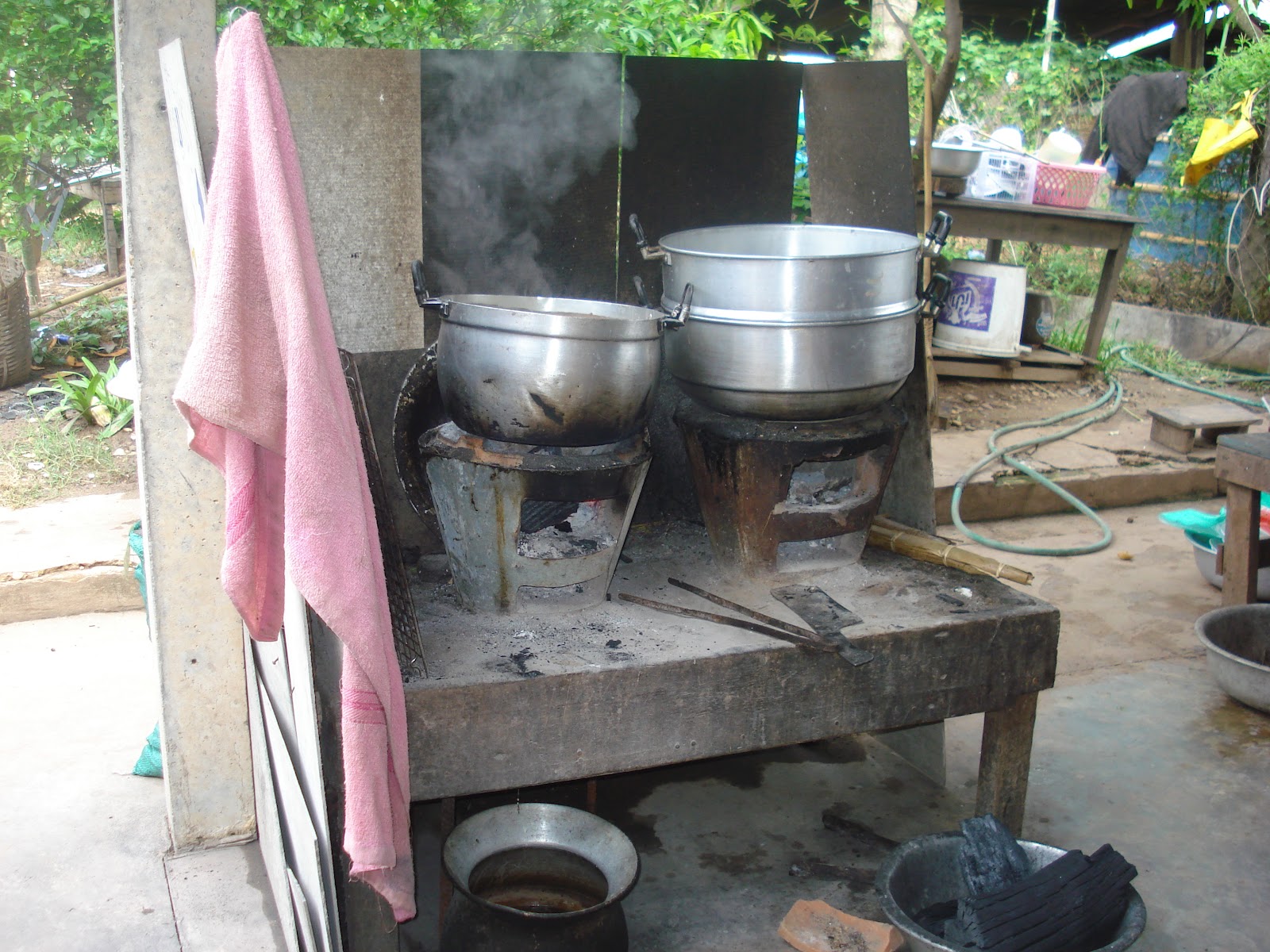
Her charcoal stove.

Her cooking set up, typical of Lao cooks everywhere, is adjacent to the house and under an awning. There’s the charcoal stove, which is a sort of stone pot or tripod for the charcoal fire upon which the pot sits, all set within a simple if sturdy framework that functions as a kind of hood or windbreak. For clean up, there’s a drainage gutter that runs behind the house and a great stone basin filled with water. This is the kitchen sink. Squatting as seemingly only Asians can do—this also explains the bathrooms—she will wash all the family’s dishes here and then prepare for the next meal.

Cooking with the pot also explains the soup-based element of Lao cuisine. Pho and khaobiak can cook all day, the longer the soup bone flavors can disseminate into the broth the better, but also keng pit, an orange broth with young egg plants, green beans, squash, basil, assorted herbs, and pork, and oum khilex, a deep green broth with pork and ant eggs, as well as various curry dishes.

Other dishes are more intensive: in dom mach hung (spicy papaya salad, the signature Lao dish) the papaya must be shredded, usually with a hand held cleaver, chopping into the green fruit and then slicing off the shreds—there food processor in Lao cooking is the mae, the mother, or her sous chefs, her daughters. Laab, too, a ground pork dish with tremendous herbs and spices, is a bit more labor intensive. Then there’s grilled meats, deep fried meats—only fish, I guess—cured meats, steamed meats wrapped in bamboo with rice and herbs, and on and on.

But perhaps I’m also not explaining the extent of the dishes here, as in dirty dishes. These are the people that eat mae Sang’s cooking: the great grandmother, her husband (who’s our connection here), two daughters, a daughter-in-law and that daughter-in-law’s sister, a son-in-law, up to five grandchildren, and at least two “cousins,” plus our party of seven, plus herself. And at any given meal there may be two-to-five new people. Let’s be conservative and say twenty people. Let’s also say that this is primarily the number at dinner, as breakfast is more unpredictable and other arrangements often happen at lunch.

Still, I’m tempted to say that magic happens in getting all those people fed, but I don’t want to diminish the work that it takes. She worksdiligently; she works religiously. But she also works evenly, she also works artfully. What she does she does with grace, without need for acclaim except the brief narrative of her day that we’re told of once so as not to lose sight of that undercurrent of respect that keeps the household afloat. Through the beauty and excellence of each dish—which have themselves, no doubt, grown and diminished over the years, have peaked and flattened out and especially deepened with her knowledge of her craft—her more significant masterpiece grows up around her, as children grow and draw in others to the family unit, as the ripples of her influence extend further and further outward from the center of her calm and artistry.

Dieth is my case in point. Dieth is a sixteen-year-old “cousin,” who, we’re told, is here studying in Savannakhet and staying with the family, though since school’s out for the year, he’s always around. Dieth has an easy smile and short, tousled hair that looks trendy but is apparently just part of his effortless good looks, and he’s quick to serve, perhaps due to his status in the family as boarder. Dieth is often at the wheel of the SUV that carts us around Savannakhet, perhaps because he’s sixteen and likes to drive (even though the legal age is 18), cranking Lao pop music via the CD player, but he also carries a good portion of the chores around the house. Unloading the charcoal truck when it drops off a score of bags, dumping and burning the trash, Dieth is always on the move.

Yesterday at noon, Dieth got his payment, or more to the point perhaps, was beneficiary of being within mae Sang’s circle of influence. A small batch of dom mach tua, a sort of mashed green beans with spice, seemed especially designed for Dieth. He ate it eagerly, voraciously, bending his head to his task intently if joyously. I enjoy dom mach tua, so I decided to elbow my way in to Dieth’s action, but first, the ever important question: Is it spicy? Pit ba? I asked and, predictably, he responded with “Ba pit.”

So far, I’ve had little trouble with spice, primarily because mae Sang is controlling it, flavoring falang (white people) dishes with less pepper than those for her own family. In moving in on Dieth’s action, I was crossing the line. I found that out soon enough.

Though excellent, the dish was very spicy for my palate. Pit li! I exclaimed. Dieth just smiled, his special blessing from mae Sang still intact.

The heir apparent to the title of matriarch is mae Sang’s oldest and married daughter Noi, who runs the house that we stay in. But Noi is a career woman of sorts, keeping a clothing shop in one of the markets that amounts to a thirty square foot cubicle in a low-roofed building of like cubicles, cramped together and close. Still, it’s a matter of some pride to her, as she invited us to see it early on in our stay and we complied. She also declares that she can set her own hours; so far, however, those hours seem very regular.

But this posture to the world raises a question. When mae Sang takes her mother’s position as respected elder, no longer directing the house through her cooking, will Noi step in and fill mae Sang’s role? And if Noi doesn’t choose to fill that role, what will that mean for the circle of influence around these households? And if this is a collective question for Lao households in Savannakhet, what will that mean for the culture?

As in many cultures, as gender roles get passed on or morph from generation to generation, these questions surround the two Meksavanh households of Savannakhet.

Friday, May 25, 2012

Culture and Posture

There's a scene in the film Namesake that I kept picturing when thinking about our trip to Laos.  In the film, Indian parents return to India with their teenage children; day one and the bratty American teens are already bored and hot, whining about returning to the familiarity of pop America.  Our kids are not teens, though one is a tween, but they can be bratty about being bored.  To temper their pre-trip excitement, I was tempted to tell them how hot it would be, how bored they would be, how there would be no American food anywhere in sight, but that, yes, we expected them to behave and enjoy themselves, darn it.

Alas, my better judgment prevailed, I said nothing, and so far so good.  Aidan is fascinated with the fauna of the place, especially the tiny geckos that linger on ceiling corners, occasionally chirp, and do very well feeding on moths in the evening, at least the external ones; Micah journals in the early morning hours and reads a bit; Sommer makes us instant coffee in the mornings and sits contentedly as auntie daily braids her hair in a seemingly infinite number of patterns.  However, we've had some help.  For example, the fact that "Tom and Jerry" was in Thai mattered not at all in the boys' fascination with it for the first two days of our trip. Now, in Laos we have fewer TV options; Tom and Jerry are gone.  Fortunately, we've broken out the Scrabble Slam deck and they're new enough to the spelling game--and our 5th grade daughter is happy enough to win consistently--that they're fascinated with it.

But we're staying in a private residence, a distant relative--or not, I can't quite tell--of Sy's, and that means trying to obey house rules, trying to quick-a-minute teach young American children the faux pas of Lao culture.  (Not that we haven't been trying to teach them along the way, but in an American context the lessons means little and our teaching was admittedly haphazard.)

Here, they stumble and stumble, we scold and scold, and they get more and more bewildered by the seeming tedium of cultural rules.

Here's a rundown:

1)  True to many Asian cultures, houses are not places for shoes; take your shoes off at the door.

2) Feet in general are dirty and disrespectful; therefore, keep feet down from chairs; sprawl onto your sleeping mat on the ground head first and feet last; keep feet down from the low table when eating on the floor; don't walk over anyone or any foodstuff--walk around thtem.

3) Respect the elderly by lowering yourself in deference to them when walking near them; this means, if you're walking and their sitting, you get down to their level. 

4) Don't ever touch the head of a person whose older than you; address elders with their appropriate title, of which their are myriad, even though generic terms of grandpa, grandma, uncle and aunt are generall though to be close enough.

It seems simple enough, yet its a dizzying list of things to remember for American children:  wrestling on the sleeping mats, the boys' feet end up directly on the pillows; Aidan goes and sits on a scale intended for vegetables; Sommer walks over a bag of bananas; she also walks directly past the centenarian grandmother standing straight up; all their feet are forever up on couches; Micah picks up an abandoned flip flop and sets it (gulp) directly on a table. 

Admittedly, we're the ones who react the strongest to these slights, trying to be aware of ourselves as guests; our hosts are gracious and unperturbed.  Also, this whole culture-crossing experience is why we're here, we must remind ourselves, especially when it becomes work to ride herd.

Of course, I am not immune to these rules myself, though my transgressions seem to come from an even larger culture--and perhaps personal--issue: body control and spacial awareness.  First, the personal side: I seem genetically predisposed to a) being somewhat of a klutz; b) I have lower spatial awareness than most, running through things--and sometimes people--rather than over them.  However, my wife also attributes some of my disregard for others' space to my Americanness: I simply am thinking of my own self and space more than others', she would argue.

Thus, in the Shanghai airport, I clip someone's feet in the waiting area; thus in a Lao market I kick a bucket (not the bucket, thankfully) in one of the narrow alleys and consequentially hear Lao exclamations in the wake behind me; thus, in a trek to downtown Savannakhet to find wi-fi with my sister-in-law, we walk single file because I outpace her and she laughs as I catch my sandals on the uneven cement panels covering the streetside gutters.  I'm an American, dang it, and I've got places to go, and in a place of many people where space is at a premium, that existential orientation becomes manifest in embarrassing moments.

My wife is good at pointing these things out, and by "good" I mean that she sees my habits for what they probably are and communicates that to me directly.  It really gives one pause.  To think that the way one conducts one's body in almost every move is culturally--and perhaps also genetically--inscribed is sobering.  Not only am I learning not to put my feet up on a couch or play with flip flops at the table.  As an adult I don't find that difficult, thank heavens.  Rather, at every moment I must try to think about myself in relation to others, to reign myself in a bit as I meet or approach people, consider personal space and posture in relation to those nearby, considering especially their ages and genders.  It adds a whole new meaning to "love your neighbor as yourself" to think about ennacting that posturally in relation to others on the sidewalk, at table, in the marketplace.  It's a posture--a posture of a certain kind of love--I certainly want to learn.

Breaking Food Rules

I’ve officially broken all the food rules that our special travel doctor insisted upon following in coming to Laos. There weren’t many: no fresh vegetables; no uncooked seafood; no tap water. Okay, in my bravado I’ve overstated the case. The only way I’ve really broken the tap water rule is through using it to brush my teeth. And by using ice of which we knew not the source, even though we were pretty sure it was legitimate. Okay, rule three is intact.


Still, rules one and two have been broached. Multiple times.

For the record, I sat across from our travel doctor, a native of India, and asked her to look me in the eye and say that, when traveling to her home country, she never ate fresh vegetables or uncooked seafood. And, in her defense, she looked me in the face and lied, saying that, yes, indeed, she always made sure everything was cooked.

My wife the prevaricator also smiled and nodded vigorously, insisting that we would follow these rules as good health-conscious citizens of the first world. I, on the other hand, wise old hand that I am, knew that we would have tremendous difficulty with rule number one for one simple reason: the Lao diet is predicated on fresh vegetables.

We broke both rules already in Thailand. We ate fresh cabbage that is a prerequisite with a dish that we had there. We also had fresh oysters in a spicy sauce. However, we assuaged our guilt by insisting that this country was safe, that in Laos it would be different—we would be different, a sentiment reinforced by our hotel proprietor who insisted that there was a significant difference between the cleanliness of vegetables in Thailand as compared to Laos, over there on the other side of the river, a mile away. Sy and I looked at each other as if to renew our vow: once crossing the border we would renew our dietary virginity and stick to abstinence.

But almost immediately after crossing, we found ourselves in so many wonderfully compromising situations. At the evening market, my mother-in-law and her friend stopped almost immediately to buy something small and seed-like. After buying some flip flops and pausing on the edge of the covered portion of the market, these seeds which were really bugs emerged. They’re buttery, we were told, and in the flow of the moment we tried them without hardly thinking: buttery indeed they were, though the texture was the difficult thing to get past, chitinous and leggy. “They taste like popcorn,” said my son, ever the simile-master. Indeed they did. But where did they fall among the food rules? Were they seafood? Certainly not. Were they cooked? At the edge of carnival of humanity that was the dalat lang—evening market—one didn’t stop to ask.

And then our hosts themselves on our first night in Laos served us fresh vegetables. How fresh? I-watched-her-climb-a-tree-and-pick-some-kind-of-leaf-and-then-serve-it-to-me-a-minute-later-on-a-plate fresh. With fresh hoi ta lee: oysters—the same dish we ate in Thailand but almost infinitely better due to the fact that the oysters were more fresh, the sauce was spicier and purer, the entire dish was topped with dried garlic, and we had this fresh-off-the-tree herb that was a soft, sweet chaser. Oh, and we also drank Beerlao—the number one beer in the world, my host informed me, and I didn’t disagree—with it. There we were, simultaneously smashing rules one and two. I should have asked for tap water to complete the clean sweep.

There’s that braggadocio again; no doubt the next post will come from the hospital infirmary. Yes, indeed, I did feel a little bit like Anthony Bourdain on the episode when he insisted what he was about to eat would land him in the hospital, but he ate it anyway. Still, when in Rome…

***

Sure enough, last night I woke up with something that felt like a cross between constipation and diarrhea. I cannot be sure it wasn’t simply too much Beerlao, bottles kept getting opened and my glass filled when I wasn’t looking. Still, when one has invested significant cash in various pills to head off diarrhea before it starts, an early morning stomach ache gives one pause: Am I beginning the final war with third world diseases?

And is it worth it? In addition to the fresh, soft tree leaves last night, we also had fresh pineapple, the characteristic acidity replaced almost entirely by a pure sweetness; fresh short bananas, I don’t know their American name but when you buy them at Walmart they taste more pasty and strongly clovish than these, which were again sweet and perfectly textured; and fresh bamboo, which is again simply purer, the texture crisp-tender yet melt-in-your-mouth sweet.

But I’m still waiting for the horror to materialize. I think my jep tong—stomach ache—was the result of the beer and not of the food, for which I’m grateful. So onwards and upwards. There’s a crop of coconuts staring at us from a palm tree on location; this and other delicacies—and adventures—await.